

VaultSage + LLM vs. Obsidian + LLM
If you are starting today, which is the better home for AI-native work?
Many people use Obsidian as the place where AI outputs, notes, prompts, and context memory live. That makes sense. Obsidian is flexible, beloved, and already part of how many people think.
So this is not an anti-Obsidian article.
If you already have a mature Obsidian workflow, you probably do not need to switch just because AI agents are getting better.
But if you are deciding where to begin now, the question is different:
Which system gives you the easiest path to working well with Claude, Gemini, ChatGPT, and future AI agents?
Our answer is VaultSage + LLM.
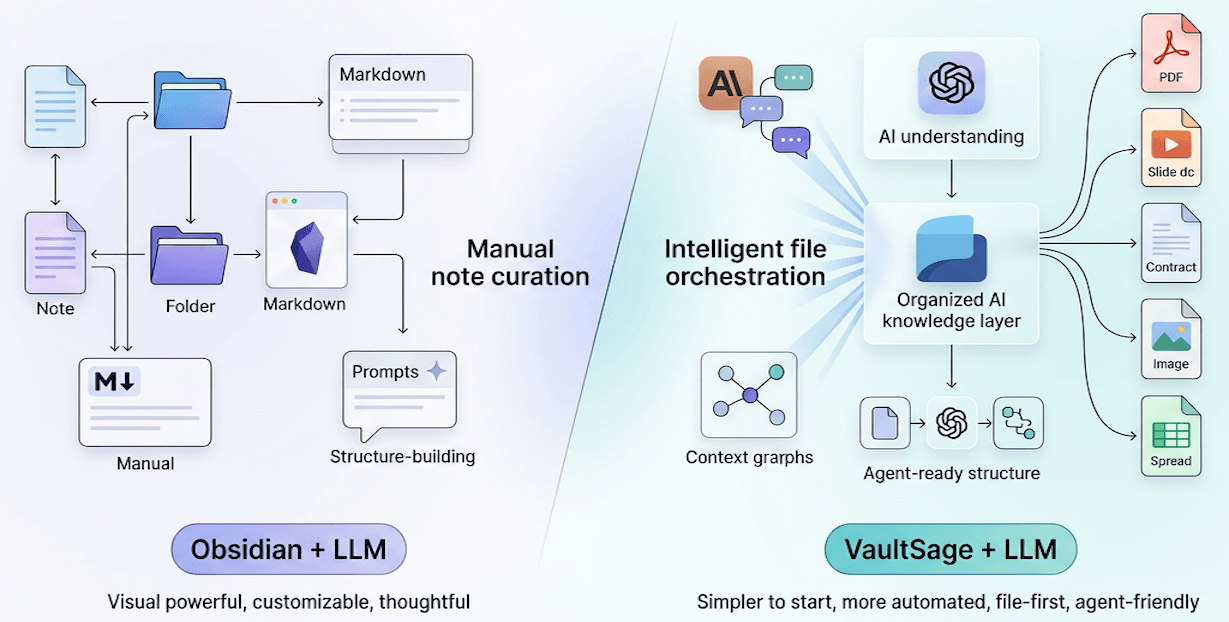
Not because Obsidian is bad. Not because personal knowledge management is dead. But because VaultSage starts from a more foundational AI-native assumption. Your knowledge does not live only in handcrafted notes. It lives in PDFs, slide decks, contracts, images, research files, drafts, and scattered documents that need to become usable context fast.
That is where VaultSage feels more natural in the AI era.
Why people use Obsidian + LLM in the first place
Obsidian is attractive because it gives people a place they control. You can build your own system, shape your own folders, define your own links, and keep everything close to your own workflow.
For many users, that is enough.
They use Obsidian to:
- keep AI outputs and notes in one place
- maintain long-term context and personal memory
- connect ideas through links and structure
- refine prompts, meeting notes, research summaries, and drafts over time
- build a system that feels deeply personal
That is real value. It is why Obsidian has such a loyal user base.
If you like crafting your own workspace, Obsidian still makes a lot of sense.
Where Obsidian + LLM becomes manual
The problem is not that Obsidian cannot work with AI.
The problem is that, for many people, it becomes a system you have to design before it becomes a system that helps you.
You are often responsible for turning messy real-world information into clean knowledge objects:
- deciding folder structures
- deciding what becomes a note and what stays a file
- deciding how context should be linked
- deciding which plugin stack to rely on
- deciding how AI outputs should be stored and revisited later
That is fine if you enjoy building your own knowledge operating system.
It is less fine if what you actually want is this:
- Upload files.
- Let AI understand them.
- Ask questions across them.
- Share them with other people.
- Keep them useful for future agent workflows.
For new users, that difference matters a lot.
VaultSage starts from files, not from note maintenance
VaultSage is not positioned as a note-taking app with AI attached later.
It is positioned as an AI-powered file management platform. In the current product language, VaultSage does not just store files. It organizes them, answers questions, and helps you share insights.
That is a very different default model.
Instead of asking users to curate a knowledge system by hand, VaultSage starts with the mess people already have:
- PDFs
- DOC and DOCX files
- PPT and PPTX files
- XLS and XLSX files
- images
- text files
- HWP and HWPX files
Uploaded files can be analyzed, enriched with metadata, searched, and turned into LLM-readable context. VaultSage can also be used for MCP-style agent workflows as a processing layer for files and context.
- Use VaultSage MCP here: https://mcp.vaultsage.ai
That means the storage layer is already aimed not only at human organization, but at AI agents as well.
VaultSage is more agent-friendly
When people say they use Obsidian as "memory" for AI, what they usually want is not just storage.
They want four things:
- durable context
- retrieval across many files
- usable structure for LLMs
- less manual cleanup between raw material and AI-ready material
VaultSage was built for that from the start.
1. It handles messy, real-world files directly
A lot of useful knowledge never becomes a polished markdown note.
It starts as:
- a deck sent to investors
- a proposal shared with a customer
- a scanned contract
- a research PDF
- a folder full of business documents
VaultSage is built around that reality. You upload the files you already have, and the system is designed to organize, analyze, and connect them automatically.
2. AI agents want output that AI can read well
LLMs work best when context is clean and structured.
VaultSage acts as a layer that parses files, performs OCR and extraction, and returns output that agents can use more directly. That matters because the real work in agent systems is often not the model call. It is the conversion from messy input into usable context.
3. It reduces setup cost and friction
With Obsidian + LLM, much of the power comes from deep customization.
With VaultSage, the value proposition is closer to:
- upload
- let the system understand the files
- search
- ask
- share
That is a much simpler model for someone who is new to AI-native knowledge workflows.
4. It becomes a shareable knowledge layer, not just a personal note tool
Obsidian is excellent when the center of gravity is your personal workspace.
VaultSage is stronger when the center of gravity is your file universe and the interactions around it. It goes beyond file organization and Q&A into sharing, access control, and insight-oriented workflows.
That makes it feel more like an AI-ready knowledge layer and less like a personal note cabinet.
Side-by-side: Obsidian + LLM vs. VaultSage + LLM
Dimension | Obsidian + LLM | VaultSage + LLM |
|---|---|---|
Starting point | Notes, vault structure, personal knowledge design | Files, documents, upload-first knowledge capture |
Setup cost and friction | Often powerful, but more user-designed | More opinionated, easier to start |
Default AI readiness | Depends heavily on how you structure and maintain the vault | Product is already framed around organizing, analyzing, and answering across files |
Real-world file ingestion | Works, but often asks the user to normalize or reorganize inputs | Built around messy business files as the default reality |
Agent friendliness | Possible, especially for advanced users | More naturally aligned with AI agents as a file processing and retrieval layer |
Sharing and collaboration | Strong for personal workflows, can be extended in many ways | More directly aligned with shareable, explorable file-based workflows |
Best fit | Existing Obsidian users and people who enjoy building systems | New users who want the easiest path to AI-native storage |
This does not mean Obsidian is obsolete
Obsidian still wins in several situations.
Obsidian + LLM is still a strong choice if:
- you already live in Obsidian every day
- your main workflow is personal note-taking and idea development
- you enjoy tuning your own system
- local-first control and deep customization are part of the appeal
- you have already accumulated your knowledge assets inside your own workspace
In those cases, the best tool is often the one that already fits how you think.
But for new users, VaultSage is the easier recommendation
If someone asks me, "I want one place where Claude, Gemini, ChatGPT, and future agents can work with my files and memory. Where should I start?"
I would not start by asking them to build a note architecture.
I would start with the tool that is already trying to become an AI-native storage layer.
That is why we think VaultSage + LLM is the better default recommendation for new users:
- it starts from the files people already have
- it is designed to organize and connect documents automatically
- it aims to make stored content searchable and question-ready
- it maps more naturally to agent workflows that need structured context
- it asks less from the user before value appears
In short:
Obsidian is great if you want to build your own system.
VaultSage is better if you want the easiest path into an AI-ready system.
A more honest framing
The right comparison is not "Which tool is universally superior?"
The better question is:
Which tool gives this person the best starting point for the kind of knowledge work they want to do?
Our view is:
- existing Obsidian users can absolutely keep using Obsidian
- new users should seriously consider starting AI-connected work with VaultSage
- the more your world is made of real files instead of carefully maintained notes, the more comfortable and natural VaultSage becomes
- the more you care about future AI agent workflows, the more VaultSage's default direction fits
That is the core difference.
Obsidian helps you build a knowledge environment.
VaultSage is trying to turn your existing file universe into a searchable brain.
Final takeaway
Obsidian + LLM is a good stack.
VaultSage + LLM is the easier starting stack for the AI era.
If you already love Obsidian, you can keep using it for AI agent workflows too.
If you are choosing from scratch and want the most agent-friendly path, start with VaultSage.