
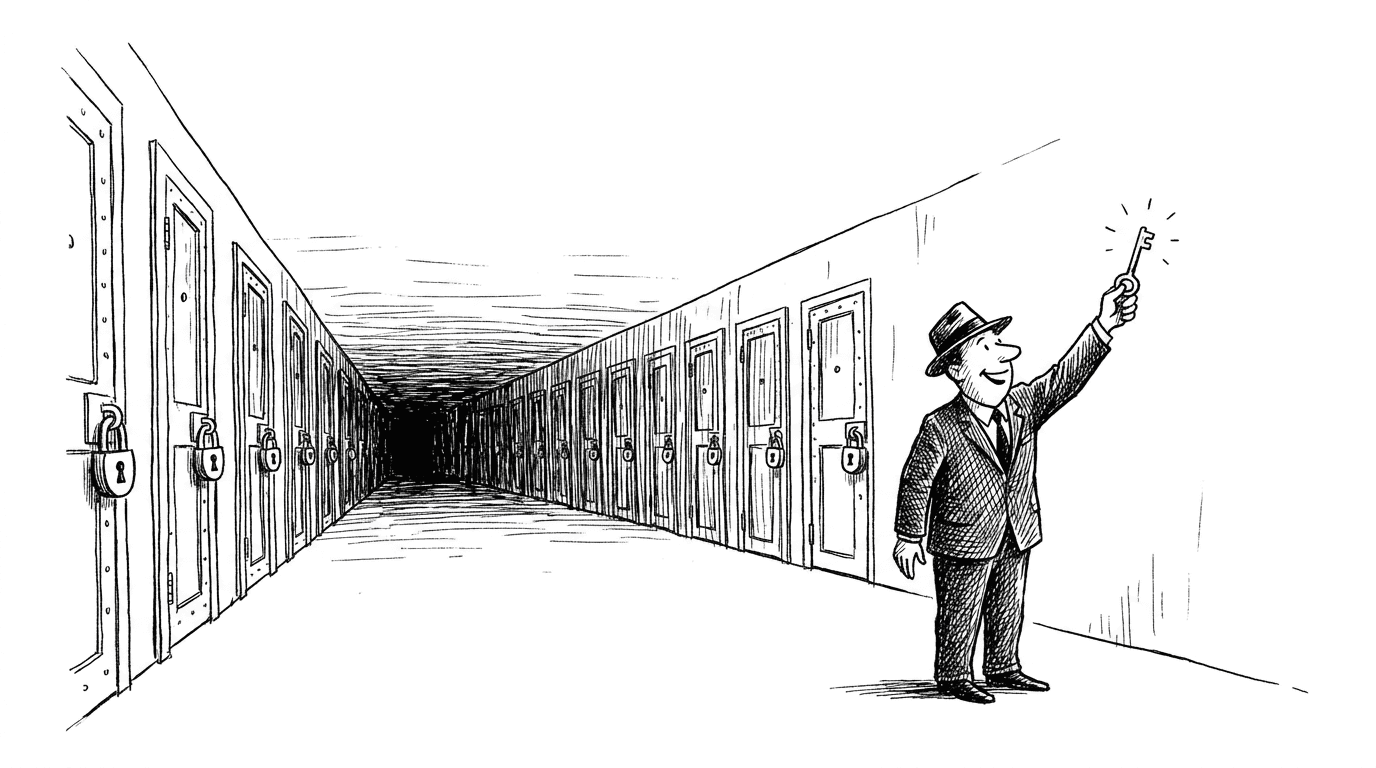
The demo went well. The pilot was a success. Everyone in the room was impressed.
Then six months passed. Then twelve. The system that worked beautifully on thirty documents quietly stalled when someone asked it to handle the entire company.
If this sounds familiar, you're not alone. According to research from McKinsey and the RAND Corporation, over 80% of enterprise AI projects fail to generate real operational value. According to Gartner, the average time to move from a successful pilot to a production environment is 6 to 18 months. Some never get there at all.
The question nobody asks out loud: if the pilot worked, why doesn't the rollout?
The Pilot Is Designed to Succeed
Here's the uncomfortable truth about enterprise AI pilots. They are almost always set up to win.
A small dataset. A controlled environment. A motivated team. A problem that's been defined precisely enough to be solvable in eight weeks.
Pilots succeed because pilots are not real. They are proof-of-concept exercises, designed to demonstrate what's possible, not to stress-test what's practical.
The moment the pilot ends and the real question begins — "how do we connect this to everything else?" — the project hits a wall.
Three Conversations That Stayed With Us
In the past year, we've had hundreds of conversations with enterprise teams trying to figure out where their AI projects got stuck. Three of them kept coming back to mind.
The head of IT at a mid-sized auto parts manufacturer told us: "We spent 200 million won building an HR chatbot. It works well enough. But connecting it to the rest of our company data? I have no idea what that would cost."
The CEO of a shipping company told us: "We subscribe to ChatGPT for our employees at the company level. But we can't let them upload files because of security concerns. Since it can't connect to our documents, employees have to explain the context every single time. And in the end, a person still has to step in."
The IT head at a civil engineering firm told us: "We want to use AI. But putting our data into it is too complicated and too expensive. We don't even know where to start."
Three different industries. Three different company sizes. One identical problem.
They all want AI to work across their organization. They all hit the same wall when they try to make it happen.

The Wall Has a Name
The wall is not a technology problem. The models are capable. The tools exist.
The wall is a structural problem: data and AI are separated by design.
Here's what the standard enterprise setup looks like today.
Someone subscribes to an AI tool. The AI tool works in its own environment. The company's documents live somewhere else — in a shared drive, a local server, a filing cabinet, a decade of scanned PDFs. When an employee needs the AI to answer something, they manually copy the context in, or re-explain the situation from scratch, or give up and ask a colleague instead.
The AI is capable. It just can't see anything.
This is why pilots succeed and rollouts fail. A pilot works with data you hand-select and manually load. A rollout requires the AI to work with the data that already exists, in the formats it already lives in, across the systems that already hold it.
That step — from "here's a clean dataset" to "here's twenty years of company knowledge" — is where everything breaks.
Why This Step Is So Hard
According to McKinsey, 60 to 80 percent of the time and effort in an AI project is spent not on the AI itself, but on data preparation and integration.
Not on the model. Not on the interface. On getting the data into a state the AI can actually read.
Every scanned invoice that isn't machine-readable. Every handwritten form that's been digitized as an image. Every PDF that was exported from a 2009 system nobody maintains anymore. Every contract stored in a format that text extraction can't parse cleanly.
Each one of these is a stop sign for an AI that was trained on clean, structured inputs.
Building around all of them is expensive, slow, and requires engineering resources most mid-sized companies don't have. So the pilot sits in the pilot environment. The rollout plan stays in the slide deck. The AI project becomes something that technically exists but practically doesn't help anyone.
The Structural Fix
The problem isn't the AI. The problem is what sits between the AI and the data.
VaultSage was built to be that layer.
When a file enters VaultSage — whether it's a clean Word document, a scanned freight invoice, a mixed-language PDF, or a handwritten form — it gets processed once. LLM plus OCR, semantic understanding, context extraction. The kind of treatment that makes a document readable not just by a human, but by any AI agent that needs to act on it.
After that, the document is permanently AI-ready. No re-uploading. No re-processing. No explaining the context from scratch every time.
The shipping company's employees don't need to choose between security and AI access. The HR chatbot can connect to the rest of the company's data without an eight-month engineering project. The engineering firm has a place to start.
The data becomes the AI's working memory, not a pile of files it can't open.
Why Now
For a long time, this problem didn't have a clean solution. Building a document ingestion layer meant custom engineering, per-format pipelines, and months of work before a single agent could run.
That's changed. LLM capabilities have reached a level where semantic understanding of messy, real-world documents is practical at scale. The infrastructure to process high volumes of unstructured files reliably now exists. And the cost of doing this — once prohibitive for mid-sized organizations — has dropped to a point where it's viable as a monthly subscription, without a systems integrator.
The pilot-to-production gap has always been about data. For the first time, closing that gap doesn't require a six-month project.
It requires uploading your files.
Try VaultSage at vaultsage.ai
💡Frequently Asked Questions
Why do AI pilots succeed but full rollouts fail? Pilots are run on curated, clean datasets in controlled environments. Rollouts require AI to work with an organization's actual data, which is messy, fragmented, and stored in formats AI systems weren't built to handle. The gap between the two is where most projects stall.
What is the main bottleneck in enterprise AI adoption? Research from McKinsey consistently shows that 60 to 80 percent of AI project time is spent on data preparation and integration, not on the model itself. The bottleneck is connecting AI to real organizational data, not the AI's capability.
How long does it typically take to go from pilot to production? According to Gartner, the average is 6 to 18 months. Many projects never complete the transition.
How does VaultSage help bridge the pilot-to-production gap? VaultSage processes documents once on upload — regardless of format, language, or age — and makes them permanently queryable by AI agents. This removes the data preparation layer that typically delays or kills enterprise AI rollouts.