The real reason enterprise AI keeps underdelivering isn't the model. It's what the model can't see.
Last week, we talked about why global trade still isn't AI-ready. Fragmented systems, legacy ERPs, and decades of human expertise that never made it into any database.
But let's get specific.
Picture the drought scenario again. A grain elevator can't fulfill its wheat contract. The trader picks up the phone and pulls from memory: years of relationship history, a handshake deal from 2019, a substitute origin sourced last season. Within hours, a workaround is negotiated and the mills keep running.
Now ask yourself: where did all of that knowledge actually live?
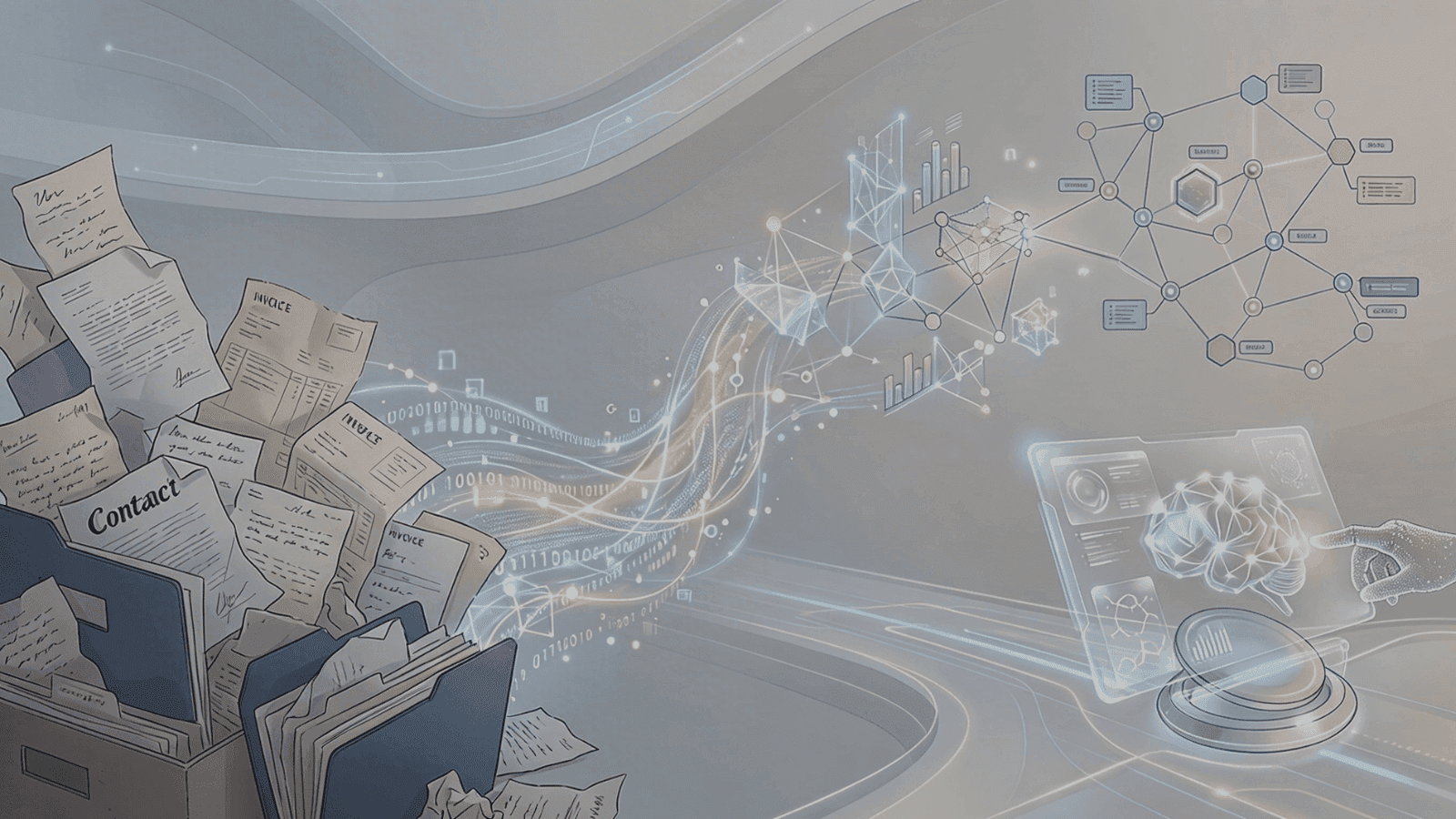
In an email thread from three years ago. In a scanned PDF that someone saved as an image. In a contract amendment that came in by fax. In a shared folder that hasn’t been opened in years.
This is the data your AI cannot read. And it's not a minor gap. It's the majority of what your business actually knows.
The Dirty Secret of Enterprise AI
Here's something nobody puts in their AI pitch deck: 80 to 90 percent of enterprise data is unstructured.
Documents, images, emails, scanned files, handwritten notes. It all exists. It just exists in formats that AI systems weren't built to handle.
The result is a pattern that's become almost comedic. Companies deploy AI, see modest gains in narrow workflows, and quietly conclude that "AI isn't ready for our industry." What they've actually discovered is that their data isn't ready for AI. The model isn't the problem. The model never got to see the relevant information in the first place.
Modern language models are capable of remarkable reasoning. But they can only reason about what they can read. Hand any of them a scanned freight invoice from 2018, a PDF with mixed-language tables, or three years of email attachments, and they'll stare back at you blankly. Very confidently. But blankly.
The Step Everyone Skips
The AI stack that everyone draws on a whiteboard: data → model → automation.
The AI stack that actually works: data → ingestion and structuring layer → model → automation.
That middle step — reading unstructured files, extracting meaning, converting raw content into something an agent can act on — has been the quiet bottleneck all along. It's not glamorous. Nobody's writing breathless LinkedIn posts about document ingestion pipelines. But skip it, and everything downstream breaks.
VaultSage was built to be that layer.
Using OCR combined with LLM processing, VaultSage ingests documents in virtually any format: scanned PDFs, images, mixed-language files, ancient exports from systems you'd rather forget. It converts them into structured, searchable, AI-readable intelligence. Not just raw text extraction — semantic understanding, context preservation, the kind of output an agent can actually use to make decisions and trigger workflows.
Think of it this way. If AI agents are the workforce, VaultSage is the onboarding process that actually explains what's in the filing cabinet.
What This Looks Like in Practice
A trading desk receives 200 documents a week. Contracts, shipping manifests, inspection reports, regulatory filings. Today, a person reads them, extracts the key data, and types it into a system.
That person is not doing low-value work. They're doing the work that the AI should be doing but can't, because the documents are invisible to it.
With VaultSage in the pipeline, documents are ingested automatically regardless of format or language. Key fields are extracted and structured without manual re-entry. That output feeds directly into AI agents customized for that organization's specific workflows: flagging anomalies, generating summaries, routing approvals, triggering alerts.
The agent at the end doesn't need to be general-purpose or particularly clever. It just needs accurate, structured inputs from the specific documents that matter to that business. That's the whole game.
For Teams Already Building
If your organization has an AI team, you already know what we're describing. You've probably tried to build something like this. You hit the wall of PDFs that don't parse cleanly, scanned images with inconsistent formatting, documents in three languages where the important field is always in the one you didn't account for.
We built VaultSage to solve exactly that. For teams already building internal AI agents, we built a way to plug this layer directly into their stack. Last month, we launched the VaultSage MCP Server. (mcp.vaultsage.ai).
For developers and in-house AI teams, the MCP server means you can connect VaultSage's document ingestion and semantic search capabilities directly into your own agent architecture, without rebuilding the ingestion layer from scratch. If your team's goal is to automate workflows that currently depend on humans reading files, this is a practical place to start.
Connect it to your existing stack. Build the agent your business actually needs.
The Order of Operations
AI agents are only as capable as the data foundation beneath them.
Before you automate, you have to read. Before you can read, every document — regardless of format, age, or language — needs to be converted into something meaningful.
This isn't a technology problem anymore. It's an implementation problem. And the implementation starts here.