

No one can deny that we are living in the era of artificial intelligence, and no one can dispute that personal data accumulated over the years is important in the age of AI. Yet, no one can clearly define which data is critical for AI and which is not.
Data is the new gold and we are all sitting on a gold mine without realizing it.
Here is a short guide to help you uncover your gold mine, so grab a shovel and let’s dig in.
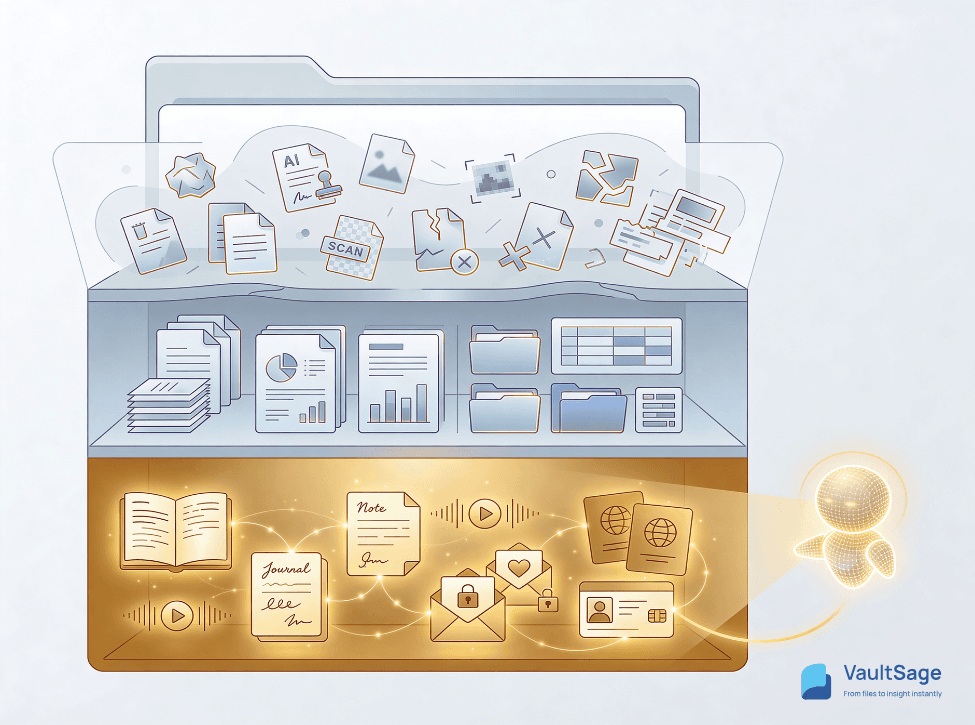
I. High-Value “Gold” Files
Gold files are about who you are. They capture your unique voice, your decision-making logic, and your emotional intelligence. Your AI uses these files to "become" a true extension of you, allowing it to ghostwrite in your style, predict your preferences, and maintain your personal brand across different platforms.
Here is a deep dive into why these files are classified as Gold:
1. The "Raw Thought" Documents (Personal Intel)
Gold files contain the unfiltered "why" behind your life. They represent the "messy thinking" that happens before a final product is created.
- Examples: Personal journals, rough brainstorming notes, voice-to-text memos, and private diaries.
- Why they are Gold: They provide the context that Silver files lack (we will cover later on) . A Silver report shows a result; a Gold note explains the struggle, the discarded ideas, and the specific intent behind that result.
- AI Value: Critical for Personalization. This data allows the AI to understand your values and belief systems, making it a better partner for brainstorming and deep work.
2. The "Communication" Archive (Linguistic Fingerprints)
These are the records of how you interact with the world.
- Examples: Sent email history, Slack/Discord exports, and personal message threads.
- Why they are Gold: In 2026, AI models are already trained on the public internet. They don't need to learn how "people" speak; they need to learn how you speak. Your emails contain your specific vocabulary, your humor, and your professional tone.
- AI Value: High for Communication. By indexing these, your AI can draft replies that are indistinguishable from your own writing, saving you hours of "tone-checking."
3. Identity Anchors
These are the files that define your professional and personal trajectory.
- Examples: Active CVs, "About Me" drafts, personal manifestos, and portfolio descriptions.
- Why they are Gold: They represent your "Official Truth." They act as the primary reference point whenever the AI needs to represent you to a third party.
- AI Value: Essential for Consistency. They ensure that when the AI helps you apply for a job or update a profile, it uses the most accurate and aspirational version of your identity.
II. Necessary but Utility "Silver" Files.
Silver files are about what you know and do. They are reliable, high-quality, but "static" documents. Your AI doesn't use them to learn your personality; it uses them as a factual encyclopedia to help you get work done.
Here is a deep dive into why these files are classified as Silver:
1. The "Outcome" Documents (Finished Work)
Silver files are usually the final versions of things you’ve produced.
- Examples: Final Project Reports, Published Articles, Signed Contracts, or completed PowerPoint decks.
- Why they are Silver: They show the AI the standard of quality you aim for. If you ask your AI to "Draft a report in my style," it will look at your Silver files to see what your finished work looks like.
- AI Value: High for imitation, but low for innovation. It knows the final result, but not the "messy thinking" (which is in the Gold files) that got you there.
2. The "Knowledge Base" (Reference Material)
These are documents you didn't necessarily write, but you own and refer to often.
- Examples: Industry whitepapers, deep-dive research PDFs, or complex cheat sheets.
- Why they are Silver: In 2026, AI models already know general facts. However, they don't know which facts you rely on for your specific job.
- AI Value: By indexing these, your AI assistant can say, "Based on that 2025 Market Research PDF you saved, here is how this new news affects your portfolio."
3. Structured "Static" Data
These are files that are organized but don't change often.
- Examples: Legal deeds, historical medical records, or tax returns from five years ago.
- Why they are Silver: They are 100% accurate and necessary for your life, but they aren't "active." They are "cold data" that the AI only wakes up when you ask a specific historical question.
III. Low-Value “Trash” Files.
Trash Files are your "System Bloat."
While Silver files provide reference and Gold files provide identity, Trash files provide nothing but confusion. These are files that occupy space without adding intelligence. In the AI era, Trash files are dangerous because they can lead to "Model Collapse" (where an AI becomes repetitive) or hallucinations (where an AI invents facts based on outdated or blurry data).
Here is a deep dive into why these files are classified as Trash:
1. The "Synthetic" Echoes (AI Workslop)
These are files created by AI that have not been significantly edited or "humanized."
- Examples: Unedited AI-generated email drafts, ChatGPT summaries you never read, and AI-generated filler images.
- Why they are Trash: Feeding AI-generated content back into your personal AI creates a "circular loop." The model begins to lose your unique human spark and starts sounding like a generic robot.
- AI Value: Negative. It dilutes your Gold data and makes your personal assistant less "you."
2. The "Generic" Reference
These are documents that are widely available on the public internet.
- Examples: Software manuals (e.g., Photoshop_User_Guide.pdf), generic templates, and public whitepapers you haven't annotated.
- Why they are Trash: Your AI was already trained on these files during its initial development. Storing them in your personal "AI Index" is redundant and wastes the AI's "context window" (its limited attention span).
- AI Value: Zero. It adds no personal value and slows down the search for your actual personal data.
3. The "Unstructured" Junk
These are files that are unreadable or irrelevant to a modern intelligence system.
- Examples: Poorly scanned receipts with no text (just images), old .exe or .dmg installers, and temporary system files.
- Why they are Trash: AI cannot derive "logic" from a broken installer or a blurry photo of a grocery list. These files are purely functional for a computer but "intellectually dead" for an AI.
- AI Value: Obstacle. They act as "dark data" that clutters your folders, making it harder for the AI to find and rank your Silver and Gold files.
Now we know what’s what. You can probably see by now that any data containing personal information or revealing what makes you unique is gold. The real challenge is separating the gold from the tailings on the drive. Would you be interested in a seasoned gold miner who can quickly pinpoint what’s valuable and discard the rest? Try VaultSage, it will automatically sort your files.
Next time, we’ll talk about how to protect that sensitive data securely.