

There's a quiet test that separates infrastructure companies from companies that sell infrastructure.
It's not pricing. It's not a certification. It's not the customer logo wall.
It's whether the team behind the platform would build their next product on it.
This year, we did. MediaSage, our AI design platform, runs on VaultSage infrastructure. Not as a marketing exercise. Not as a "look, we use our own thing." Because when we sat down to architect MediaSage, the most reliable, fastest, most boring choice was the one we already controlled.
This post is about what happened next.
The Thesis: Infrastructure Should Be Invisible
Most product teams don't think about storage. They think about features.
That's the right instinct. Storage that requires thinking is broken storage.
When we started designing MediaSage, the engineering brief was simple:
- Generate images across multiple visual language models simultaneously
- Let users edit those images without restarting the prompt cycle
- Support real-time collaboration across distributed teams
- Integrate large public datasets (in our case, KCISA's Korean cultural archives)
Every one of those requirements has a storage problem hiding inside it.
Multiple VLM outputs? You need to store, version, and retrieve them fast. Live collaboration? Concurrent access with conflict resolution. Public datasets? Ingestion of hundreds of thousands of files in mixed formats. Editing iterations? Lineage tracking so users can step backward without losing context.
We could have built that layer from scratch. We already had it.
The Client: Korea's Largest Online Education Company
Our first major MediaSage client is the print division of Korea's largest online education company. For context, this is the kind of company that produces millions of physical workbooks, practice exams, and study materials annually. Their print operation is enormous, and so is their design throughput requirement.
Before MediaSage, their design workflow looked like every other ed-tech print operation in 2025.
A designer would brief out an image concept. Someone would generate options in a single image tool. The results would come back. Most of them would miss the mark slightly. Composition wrong. Color too warm. Mood off.
Then began what we now call the prompt lottery: a designer rewriting prompts in slightly different combinations, hoping the next generation would land closer, with no way to systematically nudge the result in a known direction.
A single image could take hours to finalize. For a print division that ships at scale, this is the bottleneck.
What Changed
We deployed MediaSage with four design choices that, in retrospect, were only possible because the storage layer underneath wasn't a constraint.
1. Multiple VLMs, side by side. Instead of generating from one model and hoping, MediaSage runs the same prompt across several visual language models simultaneously. Paid tiers include GPT image generation alongside the others. Designers see a spread of interpretations in one view, which turns out to matter more for ideation than any single model's quality.
"Being able to see different models' interpretations side by side is huge for early ideation. You don't overcommit to one direction before you've actually explored what's possible."
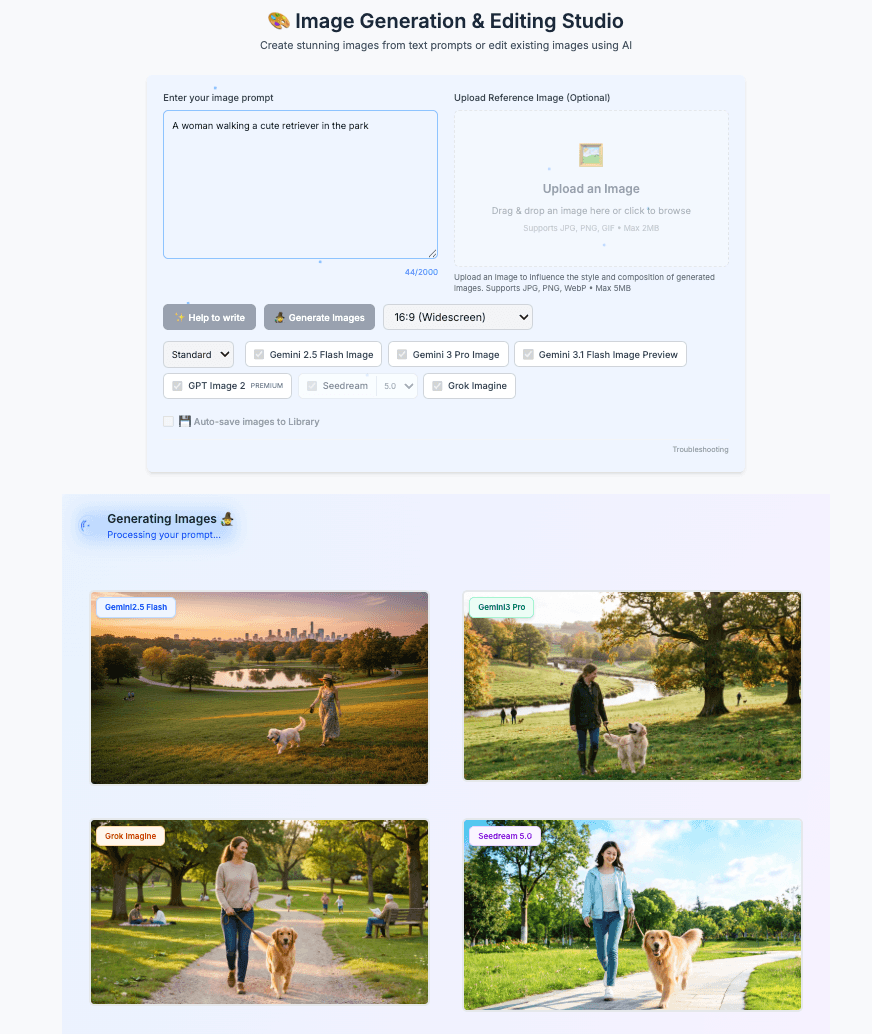
2. Editing without restarting. This is where the time savings showed up. Composition shifts, color tone, mood adjustments happen through buttons, not prompts. For finer edits, there's a wizard that lets users either refine through targeted prompts or fuse two existing images together. The point is that the editing surface is built for editing, not for re-generating.
"Editing used to mean rewriting the prompt over and over and hoping. Now it's mostly button clicks and small adjustments. The time it takes us to finalize an image dropped to about a fifth of what it used to be."
That's the headline number from our client: editing time reduced to roughly 20% of the previous workflow.

3. Live collaboration. Multiple team members work on the same generation session in real time. Art director and designer review options together without a screen share or a Slack ping-pong thread.

4. K-culture as a creative substrate. Through integration with KCISA (Korea Culture Information Service Agency), MediaSage gives users access to a large body of public Korean cultural data. Teams can build culturally specific goods, illustrations, and creative assets. Or, more playfully, users can step into historical Korean figures and generate themselves into the scene. This feature is part of why MediaSage has found unexpected traction in Japan, where K-culture has a strong audience.
What VaultSage Did Underneath
None of this is visible to a MediaSage user. Which is the point.
Every generated image, every editing iteration, every collaborative session, every KCISA reference asset is stored, versioned, and retrievable through VaultSage. The platform handles ingestion of mixed-format assets, manages concurrent access for live collaboration, and provides the search layer that makes large generated libraries usable rather than overwhelming.
If MediaSage's storage layer had been an afterthought, the product would have launched slower, scaled worse, and hit a wall the first time a power user accumulated their thousandth generation.
Instead, MediaSage went live, picked up its largest user base in Japan, grew a meaningful paid tier, and the first enterprise client we ever signed is still active.
The Next Frontier: Finding What You've Already Made
Here's where the story circles back to where VaultSage started.
Generating images is now easy. Generating good images is increasingly easy.
Finding the right image three weeks after you generated it, when you can't remember which prompt produced it and your generation history is several hundred items deep? Still hard.
This is the next thing we're building into MediaSage, and it's the thing VaultSage has been quietly preparing for the whole time. Semantic retrieval across image libraries. Reuse without re-generation. The same "your knowledge becomes searchable" thesis that powers VaultSage's document side, applied to a designer's accumulating visual archive.
Most AI design tools treat generation as the product. We think generation is the easy half. The hard half, the one that decides whether a design platform actually compounds value for its users over time, is retrieval.
Why We're Telling This Story
Two reasons.
First, because dogfooding is the cleanest signal we can send. We didn't build MediaSage as a demo or a side project. We built it as a serious commercial product, and we chose VaultSage as its foundation because nothing else would have let us move this fast.
Second, because if you're building anything AI-native in 2026 (an agent, a design tool, a domain-specific copilot, an internal automation layer), the storage problem will find you eventually. The model is rarely the bottleneck. The data layer underneath is.
VaultSage is built for that. MediaSage is what it looks like when a team trusts it enough to bet their next product on it.
🪄✨ Try It!
- VaultSage at vaultsage.ai
- MediaSage at media.nurie.ai
- Enterprise Vaultsage ent.vaultsage.ai
- VaultSage MCP Server at mcp.vaultsage.ai
❓Frequently Asked Questions
What is MediaSage? MediaSage is an AI design platform for visual content generation, editing, and collaboration. It runs multiple visual language models in parallel, includes a button-and-wizard editing interface for post-generation refinement, and supports real-time collaboration. It also integrates KCISA's public Korean cultural data for K-culture-specific creative work.
Is MediaSage built on VaultSage? Yes. MediaSage's storage, retrieval, versioning, and collaboration layers run on VaultSage infrastructure. This is intentional. We use our own platform because it's the fastest and most reliable way to build AI-native products.
Who uses MediaSage today? MediaSage is a live service. Its largest user base is currently in Japan, and the product has a meaningful paid tier. Our first major enterprise client, the print division of Korea's largest online education company, remains active.
What's the measurable impact for enterprise users? For the print division client, editing time dropped to approximately one-fifth of the previous workflow. Designers also reported significantly faster ideation due to seeing multiple model outputs simultaneously.
Why does this matter for companies building their own AI products? Most AI products fail not at the model layer but at the data layer underneath. Storage that can ingest, organize, and retrieve unstructured content at scale is the unglamorous foundation that determines whether an AI product actually scales. VaultSage is built to be that foundation, whether you're a team building your own agent stack or a company operationalizing AI across existing documents.