Is more really better than less?
For a long time, people have chased after more—more resources, more options, and more of everything. With limited time and resources, they probably chose to store up as much as they could to prepare for an uncertain future. This is because, in most cases, they have learned both directly and indirectly that having more tends to be beneficial. In many situations and on many occasions, people have assumed that more is always better.
Let’s use tools as an example: Having more tools helps people handle specific tasks more effectively. But yet, highly skilled people only need a hammer, a screwdriver, and a roll of duct tape to solve almost anything. Heck, You could repair a space shuttle with nothing but a roll of duct tape. I kid you not, NASA really used duct tape to repair space shuttles.
How about clothing? Clothing is one of the simplest ways to express who you are. Many people spend tens or even hundreds of thousands of dollars on their wardrobes. Yet some of the wealthiest people choose a “uniform”: blue jeans and a black turtleneck. If it was good enough for Jobs, I am sure it’s good enough for me too.
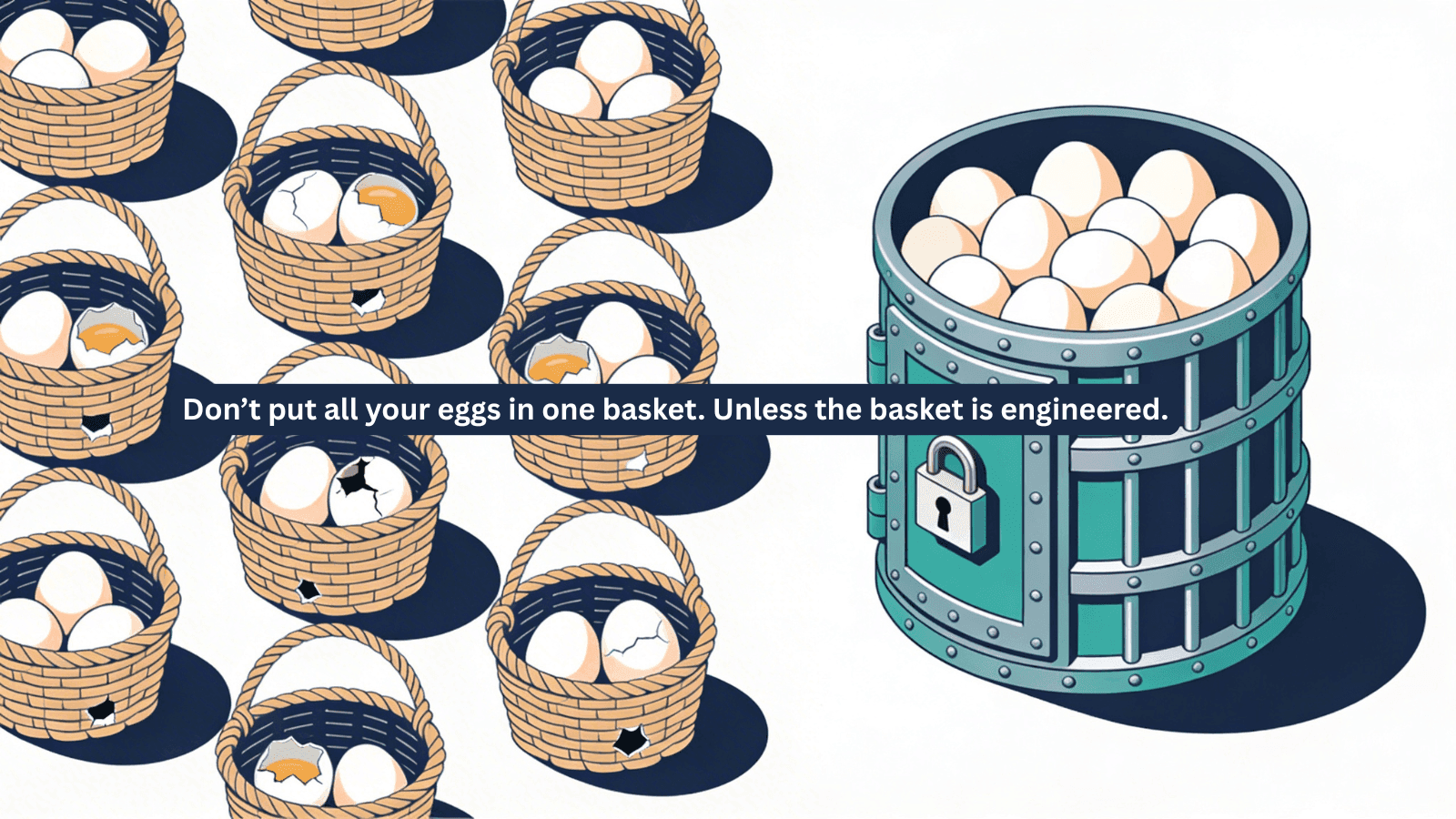
How about storage? For security purposes and functionality, many people use multiple storage solutions. Just like the egg phrase, I’m sure by now you see where I’m going with this. People say, “Don’t put all your eggs in one basket.” I say you should if the basket is reliable.
1. The "All in One, One in All" Security Paradox
It might seem counterintuitive to put "all your eggs in one basket," but in cybersecurity, a single, heavily fortified basket is much easier to defend than a hundred fragile ones. This is often referred to as Reducing the Attack Surface.
By moving to a unified vault, you aren't just tidying up; you’re fortifying. A top-tier unified provider doesn’t just promise safety; they prove it with global benchmarks:
- ISO 27001 (The Management Standard): This ensures the provider has a rigorous legal, physical, and technical framework to manage data risk.
- SOC 2 (The Trust Standard): This is the "big one" for service providers. It confirms that your data is managed based on five trust principles: security, availability, processing integrity, confidentiality, and privacy.
Instead of worrying about the weakest link in five different apps, you put your energy into one perfectly secured perimeter.
2. The "Single Pane of Glass" Visibility Paradox
In a fragmented setup, you are essentially guarding a house with ten different front doors, but you only have one pair of eyes. You have to physically walk to each door to see if it’s locked, creating Oversight Blind Spots where unauthorized access or data leaks can go unnoticed for weeks.
Unified storage solves this by providing a Single Pane of Glass—a centralized dashboard that offers total observability.
- Real-Time Threat Detection: Instead of auditing five different sets of logs, you have one centralized stream. If an employee in Marketing suddenly tries to download the entire Finance folder at 3:00 AM, a unified system flags the anomaly instantly. In a fragmented system, that trail might be buried across three different platforms.
- The "Audit-Ready" Lifecycle: When a regulator asks for a document’s history, you don’t have to piece together a "digital forensic puzzle." A unified vault provides a clean Data Lineage, showing exactly who created, edited, or moved a file from day one to the present.
- Unified Permissions Management: You eliminate "Privilege Creep." When an employee leaves the company, you disable one account and they are locked out of everything. In a multiple-storage world, it’s all too common to forget to de-provision someone from that one random Dropbox account, leaving a back door wide open.
3. The "Zero Friction" Operational Efficiency
In business, "time to find" is just as critical as "time to market." Fragmented storage forces a Search Tax on your team—those wasted 15-minute windows spent jumping between browser tabs, hunting for the "final" version of a pitch deck.
Consolidation transforms your storage from a digital junk drawer into a High-Performance Engine.
- Instantaneous Retrieval: Unified systems use a single, high-speed indexing engine. Whether you are looking for a PDF, a raw video file, or a spreadsheet, one search bar queries your entire universe of data. This moves your team from "Digital Archaeology" to "Instant Action."
- The Version Control "Truth": We’ve all seen the nightmare of Project_v1 being on Google Drive while Project_v2 is on a local server. Unified storage creates a Single Source of Truth. There is no "Wait, let me check the other drive"—the file you see is the only file that exists.
- Automated Workflow Integration: Modern unified platforms allow for Cross-Protocol Access. This means your AI tools can "read" your data, your design team can "edit" it, and your legal team can "review" it all within the same environment. You aren't moving data to the tools; you are bringing the tools to the data.
The shift from fragmented to unified storage isn't just a trend; it's a proven business advantage validated by hard data. When you centralize your data, you aren't just cleaning up your digital workspace—you are fundamentally re-engineering the cost and reliability of your entire operation.
According to a comprehensive IDC Business Value Study, organizations that migrated to a unified storage model achieved staggering results:
- 60% to 63% Improvement in IT Management Efficiency: By consolidating block, file, and object storage into a single interface, IT teams eliminated the "silo tax," allowing them to manage more data with less manual effort.
- 99% Reduction in Unplanned Downtime: A unified, software-defined architecture removes the complex "points of failure" inherent in multi-vendor, fragmented environments.
- 53% Lower Total Cost of Operations: Over a five-year period, the reduction in hardware, power, and staff time resulted in more than cutting storage costs in half.
The Egg Paradox is officially solved. Keeping files in multiple places isn't "diversification"—it's unmanaged risk. By switching to a unified, certified, and AI-driven vault, you trade chaos for control and friction for flow.
So let me ask again: Do you really think more is better than less? If you’re in the market for one reliable basket for your eggs, keep VaultSage in mind. And no the VaultSage isn’t held together with duct tape.