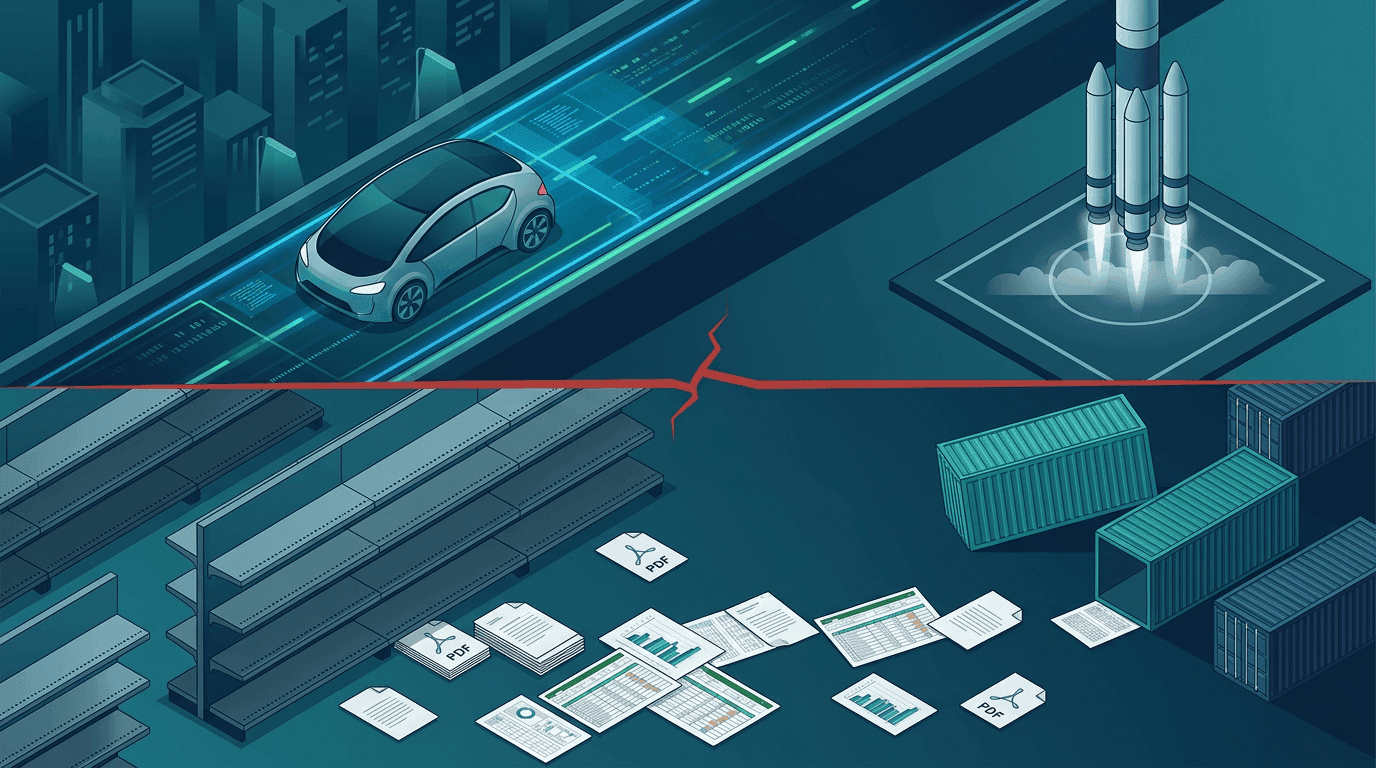
We’re living in an era where rockets land themselves and cars drive themselves. Yet not too long ago, during the pandemic, people couldn’t find a roll of toilet paper. In this day and age, robots will soon be doing our household chores, for all that high-tech progress, when the shit hits the fan, we can’t even secure a roll of toilet paper.
Does this make sense to you? It doesn’t to me. The truth is that while the world is talking about AI, the global supply chain is stuck in an analog. It isn't just "behind"—it isn't even AI Ready.
Many find the fact hard to believe because they assumed that global commercial trade had become computerized and digitized long ago. From instant shipment scheduling to satellite-enabled automated cargo tracking, there are many competitive platforms designed to make commercial trading easier. Sadly, those platforms did not help when I needed toilet paper in 2020, and they did not make the industry ready for artificial intelligence.
The core problem is not the system itself; it is our understanding of the system. For years, we have mostly recorded trade outcomes. Data like who bought what, from where, at what price, and when describes transactions, but it does not capture the operational know-how that artificial intelligence actually needs. The following three are the key components of what held back commercial trade artificial intelligence.
1. The Data Fragmentation

AI is only as good as the data it eats. Right now, global trade data is scattered across thousands of siloed systems that don’t talk to each other.
- The Reality: A single grain shipment involves farmers, elevators, rail companies, port authorities, customs, and ocean carriers.
- The Problem: Half of these players are still using legacy ERP systems from 2010—or worse, Excel spreadsheets and PDFs.
- The AI Fail: You can’t run an "Intelligent Autonomous Agent" if it has to stop and wait for a human to manually re-type data from a scanned PDF into a terminal.
2. The API Gap
To be "AI Ready," a system needs APIs—digital doorways that allow AI to see and act in real-time.
- The Proof: Research shows that roughly 92% of legacy business systems lack modern API capabilities.
- The Result: Most AI today is "reactive"—it tells you what went wrong yesterday. It isn't "predictive" because it can't see the live movement of goods through the outdated "black box" of maritime logistics.
- MuleSoft (Salesforce). (2026). 2026 Connectivity Benchmark Report: The State of Enterprise Integration and Digital Transformation. [Key Finding: Only 29% of enterprise applications are integrated; 98% of enterprises face significant connectivity challenges].
- McKinsey & Company. (2025). Legacy Tech Debt: The Silent Killer of Fortune 500 Agility. Digital & Technology Practice Insights. [Key Finding: 70% of Fortune 500 companies rely on core legacy systems older than 20 years].
3. The Paradox of Logic vs. Human Knowledge
We are stuck in a "Chicken-and-Egg" loop where legacy systems prevent AI deployment, but the real bottleneck is the Human Element. AI agents are not yet capable of communicating freely or seamlessly across the messy, unscripted reality of global trade. They rely on cold logic, whereas trade has always survived on human knowledge and relationships.
- The Communication Gap: AI can't "read the room" or understand the nuances of a crisis. It doesn't have the "chivalry" or the social capital to negotiate fairness when an environmental disaster strikes.
- The unexpected happens: Imagine a severe drought hits the Midwest, and a grain elevator suddenly can't fulfill its wheat contract because the yield is 40% lower than expected. A human trader uses their intuition and long-standing relationships to say, "I know you're short on the Hard Red Winter wheat, so let's adjust the delivery schedule and I'll find a substitute origin to keep your mills running."
- The AI Reality: Lacking these "chivalrous" connections and the freedom to negotiate, an AI simply sees a "Contract Default." It follows the rigid logic of the code—triggering penalties and legal threats
“No taxation without representation.” You might recognize this line from the movie Training Day. Even if you are not much of a moviegoer, you have probably heard it back in history class. The famous quote from James Otis, “taxation without representation is tyranny.” To put it simply: demanding obligation while neglecting responsibility is predatory. Nowhere is this more evident than in the global trade market, which has turned increasingly predatory since the pandemic.
Prior to joining NURIE AI, I worked as a grain trader specializing in edible grains—soybean, corn, wheat, and rice. At its core, the job was straightforward: I matched supply with demand across origins and destinations while managing price risk, logistics, and timing.
Like most businesses, it has its ups and downs. But for those of us in the industry, trust and fairness were always the bedrock; we believed that credibility and honoring contracts were what kept the industry alive.
Today, the players on the field—the traders—possess the deepest insights, yet the system remains deaf to their expertise. This disconnect breeds conflict and drives up costs. What we truly need before AI is Data Orchestration. VaultSage is not a replacement for existing software; it is the vital layer that bridges raw reality data with AI. By aggregating the unstructured data currently scattered across stakeholders and refining it into high-quality, actionable intelligence, we finally give the supply chain a voice. Once the system becomes transparent, global trade will no longer be predatory; it will be accountable.

We aren't here to sell another enterprise AI tool. We are here to ensure that the world's most valuable data—the ground-truth knowledge of traders and stakeholders—is no longer silenced by rigid systems. By allowing data to communicate with its own voice, we turn raw information into refined, AI-ready intelligence.
There is no taxation without representation. But we don’t mean it like Alonzo Harris or James Otis. In this new era, the order of operations has changed: First we represent, then we will talk.