

People imagine trade operations fail because something goes badly wrong. In our experience, they usually don't.
A document arrives a day late. A quantity on an invoice doesn't match the contract. A bill of lading has to be reissued. Customs waits on one missing paper while a container sits at the terminal, running up charges.
None of it makes headlines. Most of it gets fixed. The cost is the time in between.
We noticed this pattern long before we had a product for it. If you have spent any time on a trade desk, you know the day rarely goes to market analysis or negotiation. It goes to documents. Checking whether a packing list matches the bill of lading. Reading an inspection certificate one more time before releasing payment. Calling a forwarder because a document still hasn't shown up. Redoing a schedule after a vessel changes its arrival date.
It is repetitive, and it matters, and there has never been a good way to do it other than having experienced people read everything by hand. That works until the number of shipments grows. Past a certain point, the job stops being about understanding trade and becomes an exercise in keeping documents in sync.
So that is where we started. Not with a grand plan for a logistics platform, but with the smallest, most annoying version of the problem: making sure the same container number shows up correctly across five different documents, so nobody has to chase it by hand.
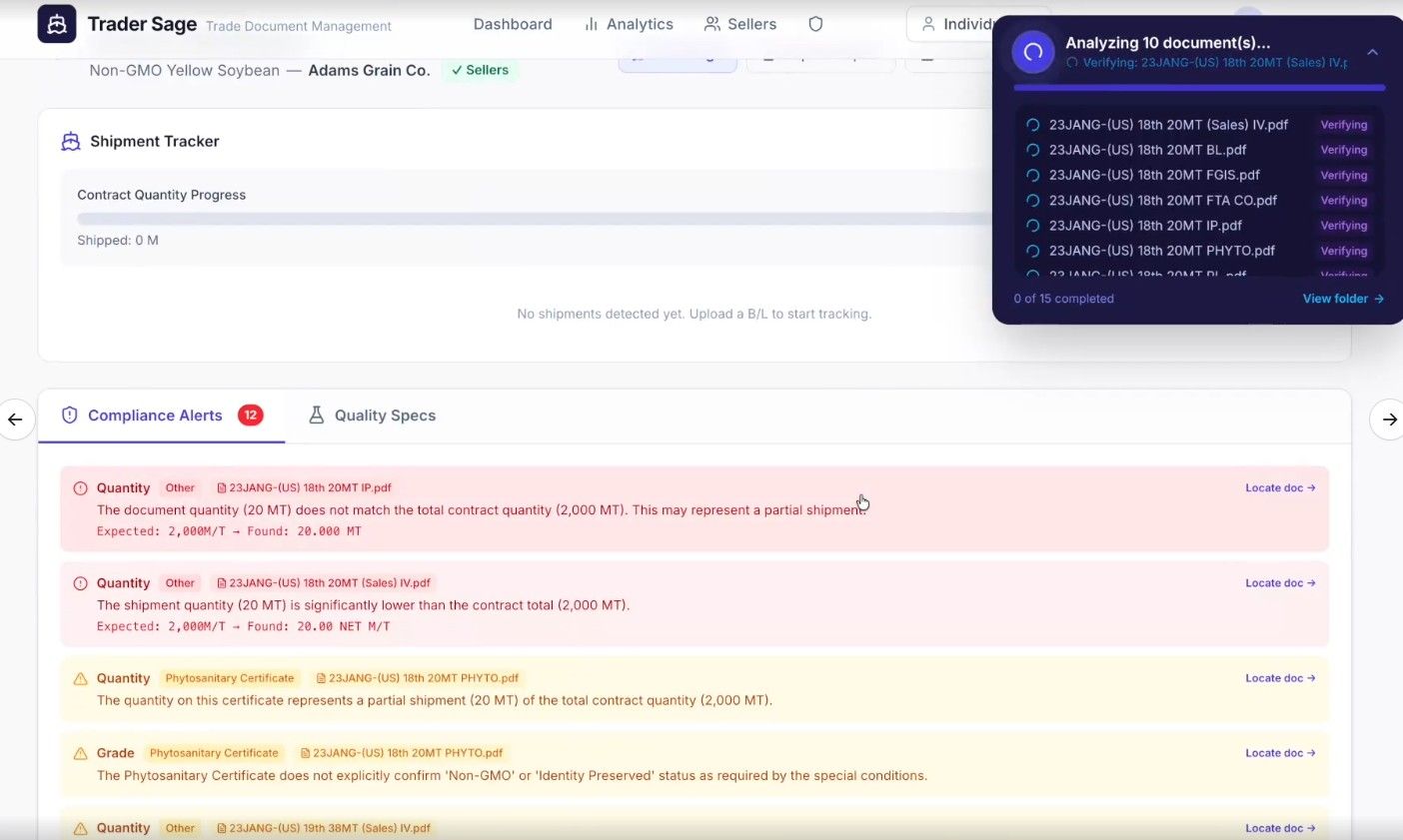
TraderSage reads trade documents the way a person would, understanding their structure instead of just pulling out fields. The contract becomes the reference point, and every invoice, packing list, bill of lading, and certificate gets checked against it and against the rest of the shipment. When something doesn't line up, it points to the exact spot, before it turns into a delayed payment or a customs hold.
Here is the part we didn't fully expect.
Customers liked it. But almost every one of them, once the document checking was working, said some version of the same thing. This is good, but what we really want is for it to keep track of the schedule too. The vessels. The dates. The voyages. The part of the job that lives in spreadsheets, forwarder phone calls, and somebody's memory.
We hadn't built that yet. So we started building it.
That is honestly how the whole thing has gone. We don't sit in a room guessing what the industry needs. We work next to trade teams, solve one operational problem, and pay attention to what they reach for next. Every proof of concept teaches us something. Every deployment adds a piece that someone actually needed in real work. Voyage and schedule tracking is where that is taking us now, because it is what customers asked for once the first problem was off their plate.
The longer we do this, the more one idea keeps coming back.
Good software doesn't replace expertise. It protects it.
A trader's value was never in remembering whether a certificate carries the right HS code or matches the contract. It is in knowing which supplier to trust, when to move, and how to hold a deal together when something goes wrong. That judgment should get more room. Everything around it should happen quietly in the background.
Trade rarely breaks all at once. It slips a little here, a little there, until someone notices a shipment has lost three days. We are building TraderSage to keep those days from slipping away. One problem at a time, with the people who live the problem.
If this sounds familiar, we'd love to talk.