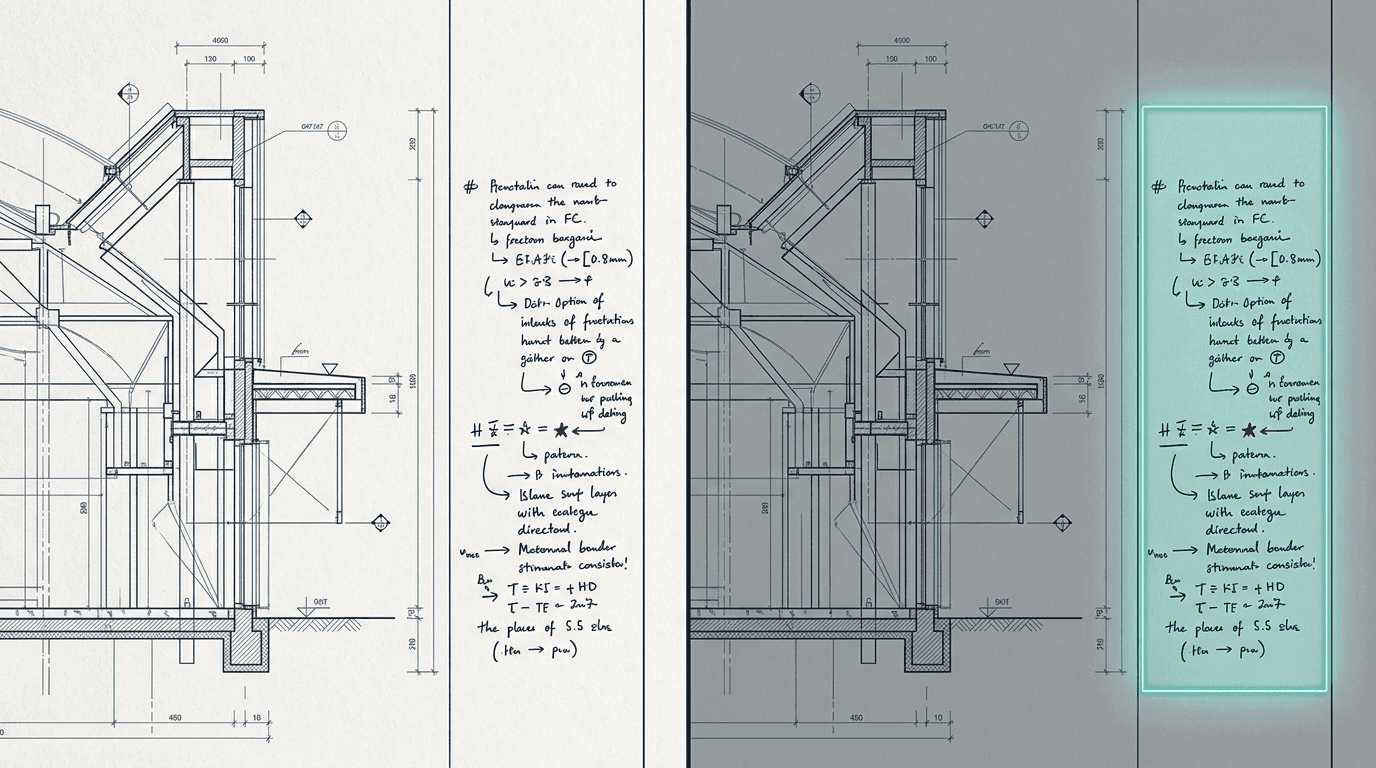
We were three slides into a product demo this week with a precision manufacturing client, walking through chat, search, summarization, and the usual tour. Then we got to a feature we honestly consider secondary: the AI can read the handwritten notes scribbled in the margin of a drawing, not just the printed CAD text.
That was the moment the room actually leaned in.
Not the multilingual chat. Not the semantic search. A margin note. Someone's handwriting next to a drawing, picked up and understood the same way the typed part was.
It made sense once we thought about it. This is a company with decades of engineering history and drawings that have passed through many hands, each one leaving a note, a correction, a "check this" scrawled next to the line it refers to. Senior staff are approaching retirement, and a lot of what they know never made it past the margin of a drawing. Nobody was looking for a clever AI trick. They were looking for the one detail their current system couldn't tell them.

That's usually how these conversations go. The pain point is rarely what we expect walking in, and the questions that follow are rarely about AI in the abstract. They're specific, skeptical, and grounded in a very particular Tuesday-afternoon problem. Here's what actually came up.
The Problem, In Their Words
Before any of the questions, there was the setup. A network drive north of 26 terabytes per division, searchable by filename and nothing else. Engineering knowledge scattered across people who are retiring without a clean way to hand it off. Duplicate CAD and drawing files sitting in inconsistent folders because nobody ever agreed on where things go. Documents mostly in Korean, with a meaningful chunk in Japanese from HQ correspondence.
None of this is unique to one company. It's the default state of any organization old enough to have accumulated real institutional memory.
What They Actually Asked Us
"Isn't this just OneDrive?" Fair question, and one we get often. Our answer: OneDrive is where files are stored and retrieved. VaultSage is what turns those files into something an AI agent can actually reason with. Storage tells you where a file is. VaultSage tells you what's in it.
"What happens to our data if we ever leave?" You can delete it directly, or migrate it out, back to OneDrive or wherever it needs to go. Once it's deleted on your end, we can't recover it. That's by design, not a caveat.
"Will it handle our CAD files?" Not natively, since CAD formats are proprietary. Convert to PDF first and it works fine from there.
"Can it actually translate our industry terms correctly?" This one had real skepticism behind it, and rightly so. Manufacturing Japanese often uses terms that mean something different on a shop floor than they do in general usage. Our position: translation grounded in the client's own documents should outperform a generic translator, because it's learning the term from the context they actually use it in. They asked for sample documents to test this directly, which is exactly the right way to verify a claim like that instead of taking our word for it.
"What about the informal, shop-floor way people actually talk?" Also holds up reasonably well, again because the context comes from their own documents rather than a general dictionary.
"Can we limit search to specific folders?" Yes.
Then Security, Which Always Comes Up

At some point in every one of these conversations, the questions shift from "can it do this" to "can we trust it with this," and this meeting was no exception.
We're SOC 2 certified, with ISO 27001 in progress. Access controls run at the folder and file level, tied to security clearance, not just team membership. Every upload and edit inside a team space leaves a full audit trail.
They also mentioned something worth noting: their authority to disclose data outside the company is limited under their Japan headquarters' policy, so their own internal IT team needs to review and sign off before the scope of any deployment is finalized.
That's a review we're glad to support directly. We can walk their IT team through our certifications, access architecture, and audit logs in whatever depth they need, and the documentation is already ready to go.
What We Took Away From It
Nobody in that room asked us to prove the AI was impressive. They asked us to prove it was accurate, reversible, and scoped to exactly what they needed. That's a better set of questions than we usually expect, honestly, and it's the right set of questions for anyone considering putting AI on top of decades of institutional knowledge.
If your engineering team is aging out faster than your documentation is catching up, we'd like to hear about it.